
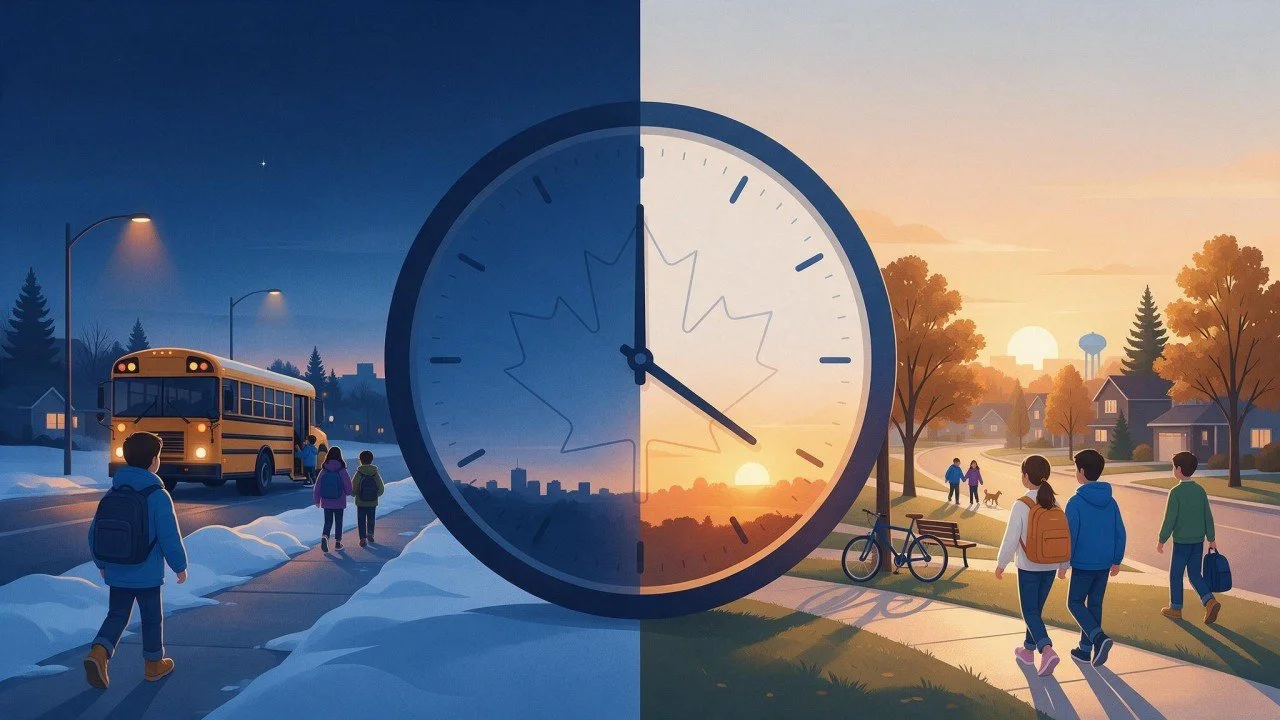
Should We Stop Changing the Clocks? It’s About More Than Convenience
… What We Should Measure Going Forward
If provinces move to permanent daylight saving time, they should not treat the decision as finished. They should commit to gathering evidence afterward, especially on how darker winter mornings affect students, families, and workers.
School boards, public-health units, and provincial ministries could track:
Absenteeism and late arrivals, particularly during the darkest weeks of winter.
Student alertness, fatigue, and well-being, using anonymous staff, parent, and student feedback.
Traffic and pedestrian safety around schools, bus stops, and rural routes.
Winter road-safety data, including collisions during morning and afternoon commuting periods, pedestrian and cyclist incidents, school-zone incidents, and crashes involving snow, slush, or ice.
Effects on adolescents, whose sleep patterns already shift later and who may be especially vulnerable to early, dark morning commutes.
Impacts on shift workers, outdoor workers, and families with early childcare or work routines.
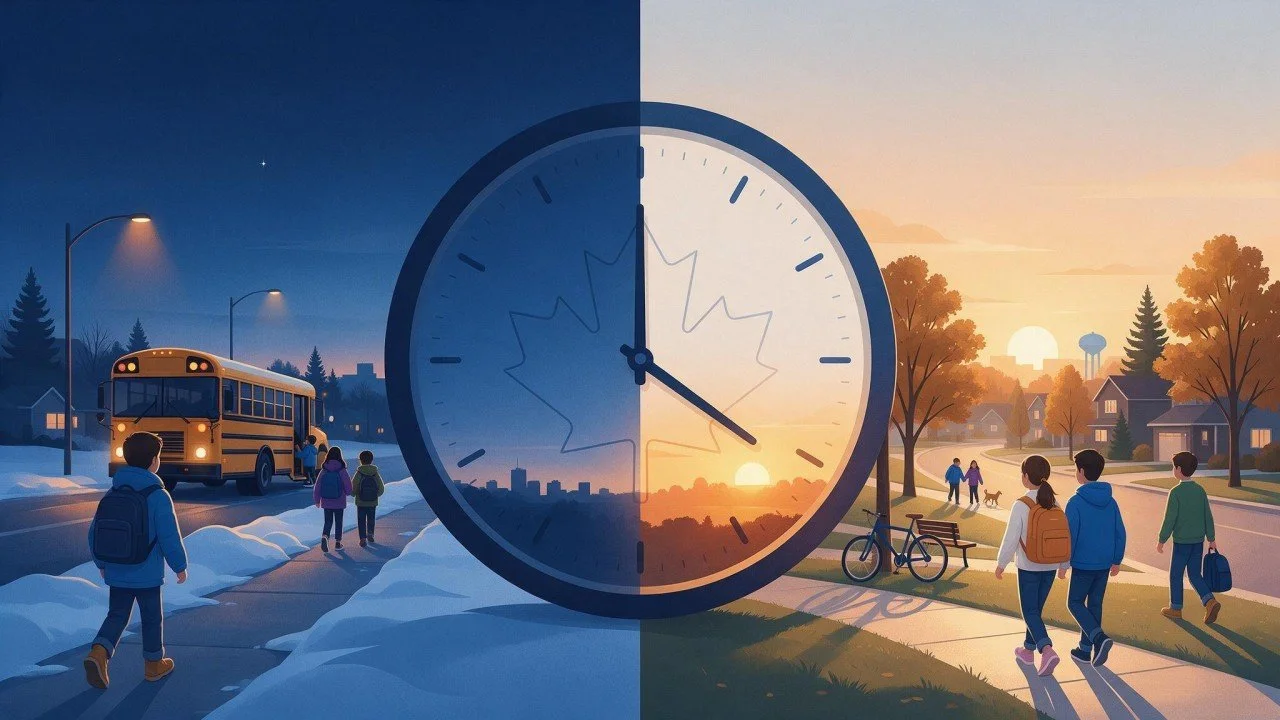
The main reason governments consider ending the twice-yearly clock change is simple: many people dislike it. But “ending clock changes” is not one policy. The real question is which time we keep - and that choice has consequences for sleep, safety, schools, work, and daily life.
There are three broad approaches:
Keep changing the clocks: Move forward in spring and back in autumn, as most of Canada currently does.
Permanent daylight saving time: Keep the summer clock year-round. Evenings stay lighter, but winter mornings become darker.
Permanent standard time: Keep the winter clock year-round. Mornings are lighter and better aligned with the body’s natural rhythms, but summer evenings are darker earlier.
People value different things: more daylight after work, brighter mornings for children travelling to school, fewer disruptions, and potential effects on sleep and health. That is why this debate is harder than it first appears.
Why Provinces Are Moving
British Columbia has adopted permanent year-round daylight saving time, calling the new arrangement “Pacific time.” The province says the goals are to improve overall health, reduce disruption for families, simplify scheduling, and provide an extra hour of evening light during winter.
Manitoba has also announced that it will remain on daylight saving time permanently, beginning November 1, 2026. Its government framed the decision as a response to public views on seasonal time changes.
Parts of northwestern Ontario - communities west of the 90th meridian, including Kenora and parts of the Rainy River district, are expected to align with Manitoba by not falling back on November 1, 2026. Ontario says the purpose is to avoid disruption for businesses, families, and Indigenous communities in the central time zone.
There is a reasonable case for these changes. Permanent daylight time can mean:
More usable daylight after the workday and school day.
Fewer twice-yearly disruptions to routines, appointments, shift schedules, and technology.
Greater consistency across provincial and regional borders for travel, commerce, and health care.
A response to clear public frustration with the current system.
In other words, provinces are not acting arbitrarily. They are prioritizing evening light, convenience, continuity, and public preference.
The Concerns We Should Not Skip
But convenience is not the same as health. Canadian researchers have argued that permanent standard time is better aligned with the body's natural circadian rhythms, which are strongly influenced by morning light and evening darkness. Their analysis highlights Canada's northern latitude and the potential consequences of permanent daylight saving time, including darker winter mornings and possible effects on sleep and health [8].
Permanent daylight saving time raises several concerns:
Darker winter mornings. Children may travel to school, and many more adults may begin work before sunrise for longer stretches of winter. [1, 6]
Sleep and circadian alignment. Later winter sunrises can make it harder for people—especially adolescents, shift workers, and early risers - to wake, function, and fall asleep on a healthy schedule. [1, 2]
Winter road conditions. Permanent daylight saving time would mean later sunrises, placing more commuters, school buses, pedestrians, and cyclists on the road in darkness during winter. Morning sunlight can help reveal hazards and may help warm or dry road surfaces; with more people travelling before sunrise, snow, slush, and black ice could become harder to detect. A recent Canadian Medical Association Journal analysis notes that permanent daylight time would leave more Canadians commuting to school and work in darkness during the coldest months, and recommends monitoring injuries and other health outcomes if jurisdictions adopt it. [1, 6, 7].
Road and pedestrian safety. Darker mornings can affect visibility for young pedestrians, cyclists, drivers, and school-bus routes. [1, 3]
Equity. The benefits and burdens are not evenly distributed. Outdoor workers, rural commuters, parents of young children, and people with early start times may experience the trade-offs differently.
Regional fragmentation. If provinces and regions adopt different systems, Canada could end up with a patchwork of time rules. That may create confusion for businesses, families, broadcasters, transportation, and cross-border coordination.
Oversimplified health claims. It would be misleading to say permanent daylight time is either clearly harmful or clearly beneficial in every respect. A recent systematic review found that the evidence is limited and mixed: spring transitions have been associated with short-term increases in heart attacks and fatal traffic crashes, while some outcomes differ depending on the transition, season, and population studied. [3]
That last point matters. The strongest consensus among sleep researchers is not simply “daylight saving time is bad.” It is that seasonal switching carries costs, and that permanent standard time is the option most consistent with human biology.
The road-safety evidence is also more nuanced than headlines sometimes suggest. Canadian research has found a short-term increase in collisions following the spring clock change, while broader reviews find mixed results on whether shifting light from morning to evening improves or worsens overall road safety. That uncertainty is exactly why jurisdictions considering a change should monitor real-world outcomes rather than assume either a benefit or a harm
What We Should Measure Going Forward
If provinces move to permanent daylight saving time, they should not treat the decision as finished. They should commit to gathering evidence afterward, especially on how darker winter mornings affect students, families, and workers.
School boards, public-health units, and provincial ministries could track:
Absenteeism and late arrivals, particularly during the darkest weeks of winter.
Student alertness, fatigue, and well-being, using anonymous staff, parent, and student feedback.
Traffic and pedestrian safety around schools, bus stops, and rural routes.
Winter road-safety data, including collisions during morning and afternoon commuting periods, pedestrian and cyclist incidents, school-zone incidents, and crashes involving snow, slush, or ice.
Effects on adolescents, whose sleep patterns already shift later and who may be especially vulnerable to early, dark morning commutes.
Impacts on shift workers, outdoor workers, and families with early childcare or work routines.
This matters because school timing and light exposure are not minor details. Research on later school start times has found associations with better attendance, less tardiness, improved sleep, and stronger academic outcomes; conversely, permanent daylight saving time can push more students into pre-sunrise travel during winter. [4, 5]
A recent Canadian analysis also recommended that jurisdictions choosing permanent daylight time should evaluate the change and monitor possible effects on schooling outcomes, particularly for adolescents. [1, 7]
In practical terms, that could mean a scheduled review after one or two winters: comparing attendance, punctuality, incident reports, and wellbeing data before and after the change, while paying particular attention to rural and northern communities where sunrise arrives later.
My View
Ending the clock changes may make life simpler. It may also give people more evening daylight, reduce disruption, and respond to a widely shared frustration.
But simplicity alone does not tell us which time best protects sleep, safety, learning, mental health, and daily functioning. If provinces move to permanent daylight saving time, we should build in a commitment to measure the results - absenteeism, late arrivals, safety, sleep, and student well-being - rather than assuming the benefits will outweigh the costs.
That is the part worth examining carefully.
References
Here are the core references with the links embedded directly in the titles:
Sleep Research Society, It Is Time to Abolish the Clock Change and Adopt Permanent Standard Time
Systematic Review, Daylight-Saving Time and Health: Beneficial and Adverse Effects
Implications of Sleep Health Policy: Daylight Saving and School Start Times
Middle School Start Times and Young Adolescent Sleep, Behaviour, and Outcomes
Permanent Daylight Saving Time and Dark Morning School Commutes
Canadian Analysis: Clocks Stay in Daylight Saving, but Evidence Backs Permanent Standard Time