
Creating a More Sustainable Digital World Is a Responsibility We All Share
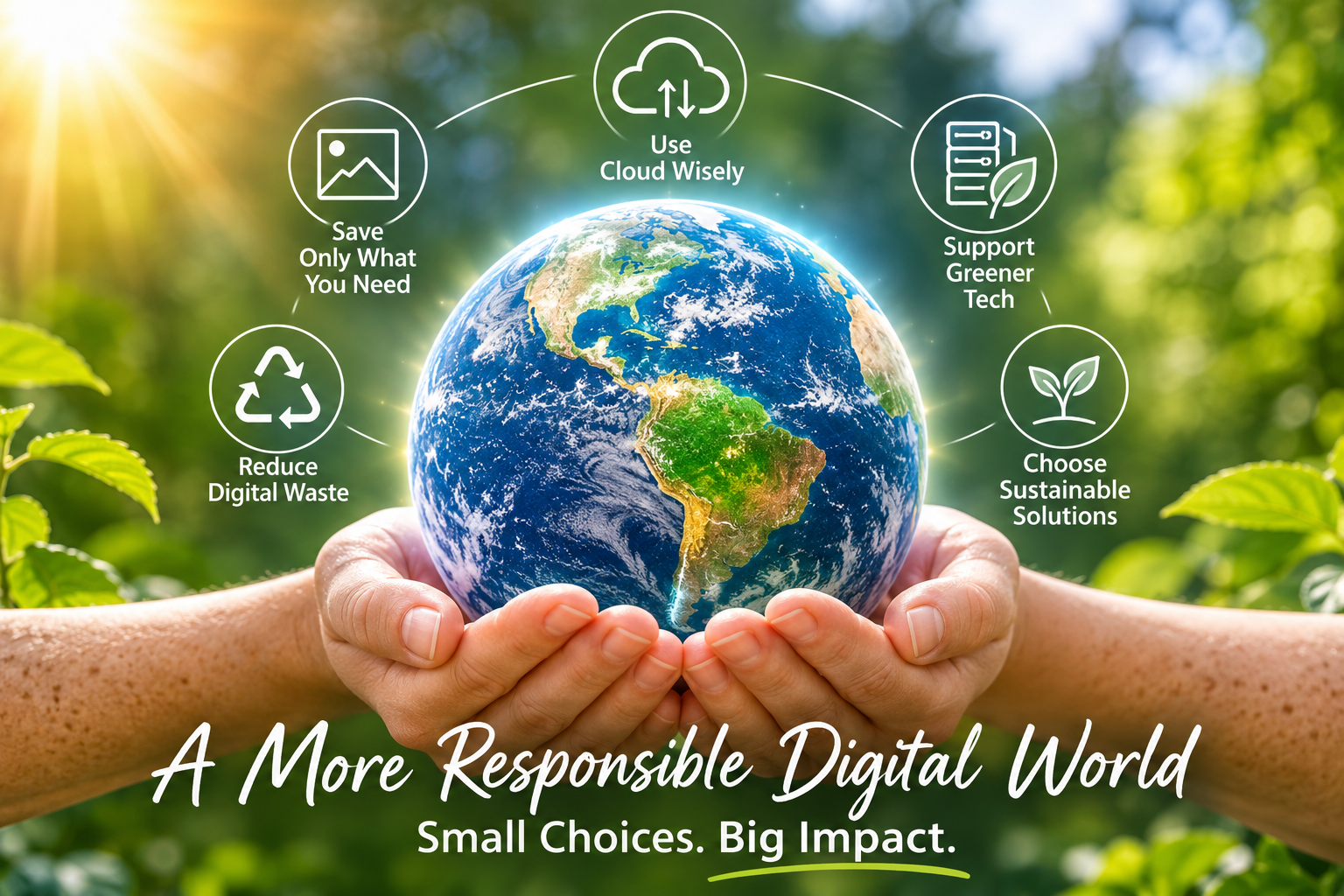
How can technology companies, governments and users share responsibility for making our growing digital world more sustainable?
A Simple Question That Got Me Thinking
Recently, I used AI to create an image. I downloaded it to my computer, took a look at it, and then realized something: I would probably never use that image again.
That got me thinking. What happens to that image after I have downloaded it? Does another copy remain stored on the platform? How long is it kept? What happens to the countless images and videos people create, download once, and then forget about?
We are living in a time when creating digital content is easier than ever. With a few words and a click, we can generate images, videos and other content in seconds. The possibilities are exciting, but I began to wonder whether we are paying enough attention to what happens to all that digital content once we have finished using it.
Data centres support our communication, businesses, banking, research, entertainment and increasingly, artificial intelligence. They are not going away. But as our use of AI grows, shouldn't we also be asking how we can use these resources more responsibly?
What Happens to the Images and Videos We Create?
When we create an image or video using an AI platform, computing resources are required to generate it. The content may also be stored on the company's servers or cloud infrastructure. However, what happens after creation depends on the platform and its policies.
Some platforms may retain generated content, prompts and related information for a period of time. Others may provide options to delete content or manage how long it is retained. Even when a user downloads an image to their own device, that does not necessarily mean the platform's copy has been deleted.
There is another important distinction: deleting something from a visible library or account does not always mean every copy disappears immediately. Backups, security logs and records retained for operational or legal reasons may be subject to different retention periods.
These practices are not necessarily the same across AI companies. Users should not have to search through lengthy privacy policies to understand what happens to the images and videos they create.
We should be told clearly, at the time of creation, what is being stored, where it is being stored, how long it will be retained, and how we can delete it.
What if 30 Days Became the Standard?
Here is one idea I would like to put forward for discussion.
What if AI platforms adopted a 30-day default retention period for generated images and videos?
When someone creates an image or video, the platform could clearly explain that the content will be retained for 30 days. During that time, users could download anything they wish to keep. If they want the content to remain in their online account for longer, they could actively choose to retain it.
After 30 days, the content would be automatically removed from active storage unless the user had chosen otherwise. Companies would also need to explain clearly whether copies might remain temporarily in backups or be retained for legitimate security, legal or operational reasons.
This would not prevent people from keeping their creations. They could save images and videos to their own computers or external hard drives, just as we have done with photographs and other digital files for years.
The idea is not to take away convenience or limit creativity. It is to give users more control over what remains stored in the cloud, to encourage more thoughtful digital habits and to limit what is stored in the cloud.
I recognize that 30 days is a proposal, not an established industry standard. I also recognize that we need experts to determine whether shorter retention periods and more user-controlled deletion would meaningfully reduce storage requirements, energy consumption, water use or the need for additional data-centre capacity.
But shouldn't we at least be asking the question?
Shared Responsibility
This is a conversation about recognizing that the choices made by companies, governments and individuals who all contribute to how our digital world develops.
Technology companies have an opportunity to lead by making responsible storage practices part of their design. They can provide clear retention information, simple deletion options, user-controlled storage settings and more efficient infrastructure. They can also help users understand the environmental considerations associated with the services they use.
Governments and policymakers have a role in establishing expectations for transparency, responsible resource use and accountability. Canada has begun addressing these issues through its Responsible Data Centre Development Principles, which call for data centres to minimize water use and environmental impacts, be transparent about local impacts and create lasting benefits for the communities in which they operate. These principles provide an important foundation for responsible infrastructure development. They do not, however, establish retention periods for AI-generated content. (3)
Users also have a role to play. We can be more intentional about the images and videos we create, download what we want to keep, delete what we no longer need, and think carefully about whether everything we generate needs to remain stored online.
Small choices may not solve a much larger infrastructure challenge on their own, but responsible digital habits are part of the conversation.
The Environmental Questions We Need Experts to Answer
There is a growing conversation in Canada about the energy demands of data centres and the infrastructure needed to support AI.
In an October 2024 report, the Canada Energy Regulator estimated that 239 data centres were operating across Canada and noted that the industry was expanding. The report also identified the growing use of artificial intelligence as a significant factor contributing to increased energy demand. (1)
Research is also examining the wider environmental effects of these facilities. A 2026 University of British Columbia Sustainability Scholars report, prepared for Metro Vancouver, considers how large AI data centres could affect electricity demand, greenhouse gas emissions and local air quality. It also examines different power configurations and potential ways to reduce environmental impacts. (2)
These Canadian sources help establish why the issue deserves attention. However, I believe we need more specific research to understand the relationship between digital content retention and the resources required to store it.
For example:
How much storage capacity is being used to retain AI-generated images and videos that users may never access again?
What proportion of data-centre energy consumption is associated with storing this content, compared with generating it and other computing activities?
Could shorter default retention periods reduce the amount of storage infrastructure required?
Would more user-controlled deletion practices make a measurable difference to electricity consumption, cooling requirements or water use?
What would be the environmental impact of giving users the option to download and retain their own content rather than keeping everything in the cloud?
I don't have the answers to these questions, and I don't believe we should invent numbers to make an argument. These are questions for data-centre operators, engineers, environmental researchers and energy experts.
Storage is only one part of a data centre's overall resource use. Generating AI content also requires computing power, and cooling systems can have their own energy and water demands. Any proposed changes to storage practices need to be evaluated within that bigger picture.
What I would like to see is research that helps us understand whether more thoughtful retention policies could make a meaningful contribution to reducing the environmental footprint of our digital activities.
Innovation Should Include Responsibility
We are often encouraged to embrace new technology, explore its possibilities and take advantage of the opportunities it creates. I agree. AI can support creativity, education, research, business, and so much more.
But innovation should not be measured only by what technology allows us to do. It should also be measured by how responsibly we use it and how thoughtfully we manage the resources required to make it possible.
We cannot expect every user to understand the complexities of cloud storage, data-centre infrastructure or environmental impact. Technology companies need to make responsible choices easier, and governments need to encourage transparency and accountability.
At the same time, we can all pause before creating, storing, and keeping more digital content than we need.
We have extraordinary tools at our fingertips. Let's make sure we use them responsibly.
Just because we can store everything, should we?
It is a responsibility we all share.
References
Canada Energy Regulator. (2024, October 2). Market Snapshot: Energy demand from data centers is steadily increasing, and AI development is a significant factor.
https://www.rec-cer.gc.ca/en/data-analysis/energy-markets/market-snapshots/2024/market-snapshot-energy-demand-from-data-centers-is-steadily-increasing-and-ai-development-is-a-significant-factor.htmlKhurana, K. S. (2026, August). Impacts of Large Data Centres on Energy Demand, Greenhouse Gas Emissions, and Local Air Quality. UBC Sustainability Scholars, prepared for Metro Vancouver.
https://sustain.ubc.ca/about/resources/impacts-large-data-centres-energy-demand-greenhouse-gas-emissions-and-local-airInnovation, Science and Economic Development Canada. (2026). Canada's Responsible Data Centre Development Principles. Government of Canada.
https://ised-isde.canada.ca/site/ised/en/data-centres-powering-canadas-digital-future-responsibly/canadas-responsible-data-centre-development-principles
