
Before Everyone Runs Out the Door… One question. One connection.
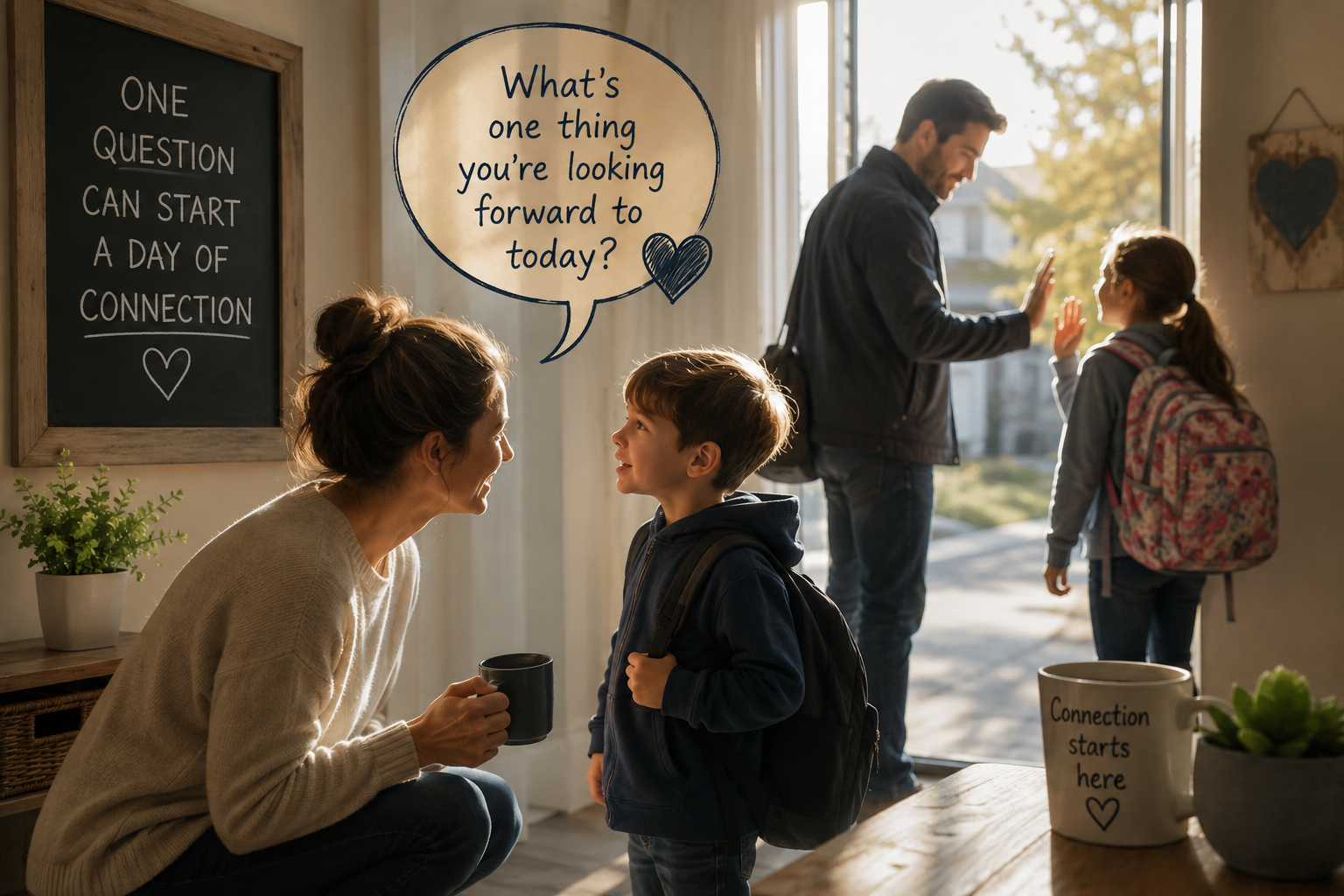
Years ago, someone shared a simple family tradition with me that I’ve never forgotten.
Every morning, before everyone heads out the door, each person answers one question:
“What is one thing you’re looking forward to today?”
Everyone answers.
Not just the kids.
The adults too.
Maybe it’s something at school. Maybe it’s seeing a friend. Maybe it’s a meeting. Maybe it’s recess.
Then everyone heads out the door.
But the conversation doesn’t end there.
At dinner, they ask the follow-up:
“How did that thing you were looking forward to go?”
Maybe it went wonderfully. Maybe it didn’t happen. Maybe it was a complete disaster.
And that’s okay.
Everything is on the table.
I love this simple tradition because it isn’t really about the question.
It’s about what the question creates. It creates a reason to talk.
It tells children:
What happens in your day matters to me.
Research on parent-child conversations about setbacks gives us a reason to think about this. In a study of 231 mother-child pairs, researchers found that when mothers acknowledged their children’s emotions and discussed ways to work collaboratively on future problems, this was associated with less fear of making mistakes in children. [1]
But there is another piece of this that I think is especially important.
Children are watching us.
If we expect children to be able to say:
“That didn’t go the way I hoped.”
“I made a mistake.”
“I’m disappointed.”
“I don’t know what to do next.”
Then perhaps they need to see that we can say those things too.
Not because children need to carry our adult problems. They don’t. But because they need to know that being human isn’t the same thing as being perfect.
Research on parental emotion socialization has found that the ways parents respond to, discuss, and express emotions are connected with children’s emotional and social development. [2]
Additional research by Haimovitz and Dweck found that parents’ views of failure were related to their children’s developing beliefs about learning and intelligence. In other words, children notice how we think and talk about failure. [3]
That matters.
Because I don’t want children to grow up believing that success means never getting it wrong.
Sometimes we get it right. Sometimes we get it wrong. Sometimes we don’t know. Sometimes we have to try again. And sometimes the thing we were looking forward to doesn’t turn out the way we imagined.
That’s life.
Our job isn’t to remove every disappointment. It’s to help children know that they can move through it.
And perhaps that’s what I love most about this family’s morning question. It starts before anything has gone wrong and creates connection when things are good.
And then, when the day doesn’t go according to plan, there is already a pathway back to the conversation.
“Tell me about it.”
No fixing. No judgment. No pretending. Just a family making room for the good, the hard, the unexpected, and everything in between.
So, as families head out the door for a new school year, perhaps try one simple question:
“What’s one thing you’re looking forward to today?” And then remember to ask about it later.
Because sometimes one small question can become a much bigger conversation.
A little research behind this idea
[1] Peterson, E. R., Sharma, T., Bird, A., Henderson, A. M. E., Ramgopal, V., Reese, E., & Morton, S. M. B. (2024). How mothers talk to their children about failure, mistakes and setbacks is related to their children’s fear of failure. British Journal of Educational Psychology, 95(1), 124–142. https://doi.org/10.1111/bjep.12685 (PubMed Central (PMC))
[2] Eisenberg, N., Cumberland, A., & Spinrad, T. L. (1998). Parental socialization of emotion. Psychological Inquiry, 9(4), 241–273. https://doi.org/10.1207/S15327965PLI0904_1 (PubMed)
[3] Haimovitz, K., & Dweck, C. S. (2016). Parents’ views of failure predict children’s fixed and growth intelligence mind-sets. Psychological Science, 27(6), 859–869. https://doi.org/10.1177/0956797616639727 (Association for Psychological Science)
This article was published on Substack. Subscribe to Lynn’s page for free.
